


日本語 (Japanese site)

Care and NursingCare and Nursing

The Difference Between "Care Worker" and "Nurse"

Many people misunderstand the difference between the work of a care worker and a nurse. This page explains it clearly, kanji character by kanji character.

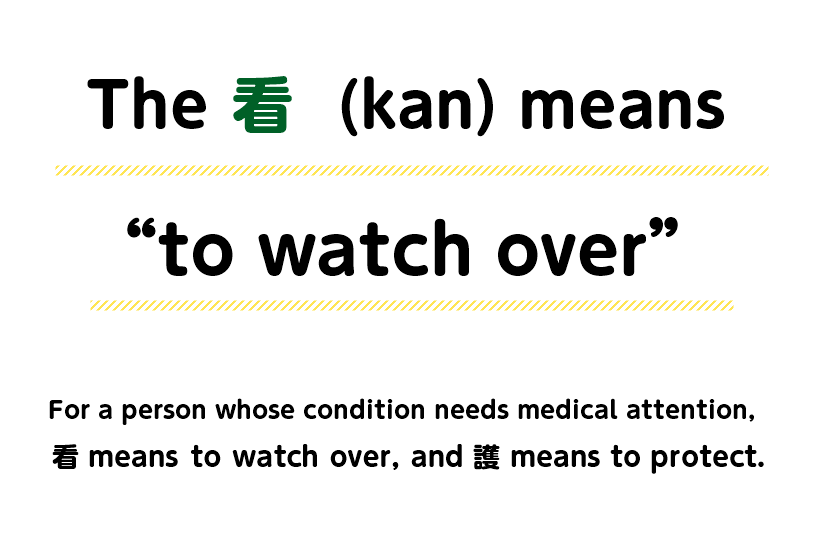
The difference between "介" (kai) and "看" (kan)

Shinshu Sports Medical & Welfare College - the kanji 介 (care)
Care
"Care" refers to work supporting daily life activities such as meals, toileting, changing clothes, and bathing for people who cannot manage daily life on their own (people who need assistance).
Shinshu Sports Medical & Welfare College - the kanji 看 (nursing)
Nursing
A "nurse" is treated as a "medical profession" that provides personal care and assists with medical examinations for patients who require medical treatment.

Difference in jurisdiction

Care
"Care Worker" is a welfare profession, under the jurisdiction of the Ministry of Health, Labour and Welfare's Welfare Division (along with other roles such as Certified Social Worker).
Nursing
"Nurse" is a medical profession, under the jurisdiction of the Ministry of Health, Labour and Welfare's Medical Affairs Division (the same as physicians, acupuncturists/moxibustionists, and judo therapists).

Difference in the workplace

Care
In a "care facility," the person being supported is referred to as a "resident/user," a term for someone using the facility. Care workers mainly interact with these residents.
Nursing
In a "hospital," a person suffering from illness is referred to as a "patient." Since this takes place within a hospital, nurses mainly interact with patients.

Difference in what is studied

Care
Care Worker students learn about "the structure and function of the body," but do not study "anatomy and physiology" in depth.
Instead, they focus more on understanding people, including psychological elements such as "human dignity and independence."
They also learn the technical skills involved in supporting daily living, mastering them by repeating practical training (on-campus classes) and internships (off-campus training).
In recent years, since care workers now also handle some medical procedures (such as sputum suction and IV drip changes), this has been added as a required part of the curriculum.
Nursing
Since nurses are heavily involved in "medical procedures" such as assisting physicians with examinations, they study subjects including anatomy and physiology, pathophysiology, pathology, pharmacology, nutrition, and clinical laboratory science.
Of course, they also study psychological elements such as "human relations theory."
They also study fields related to social welfare.
One key difference is that nurses are qualified to handle syringes/injections.

Care and Nursing

Both "Care Workers" and "Nurses" provide personal care to "patients" within a hospital, so at first glance the roles can seem hard to tell apart. However, within a hospital there is a hierarchy: the physician first, then the nurse, and then the care worker. This is similar to the hierarchy for judo therapists within a hospital's rehabilitation facility. Physician first, then nurse, then PT or OT, then judo therapist. For judo therapists, one major difference from PTs and OTs is that they are legally permitted to open their own practice. In "special nursing homes for the elderly," the "care worker" is generally the main professional on site. Physicians and nurses are also present, but mainly step in when a medical need arises.

The difference between care and nursing - Shinshu Sports Medical & Welfare College

About the workplace

What they have in common: "assistance"
  • Obtaining the Care Manager qualification
  • Care workers, nurses, and other licensed professionals such as judo therapists and acupuncturists/moxibustionists each carry out their own specialized duties, and after 5 years, they can take the Care Manager course and obtain the qualification.
  •  
Both care and nursing are the same in that they support the daily lives of elderly people and people with some form of physical disability.
The role of care is to respect the person who needs support, and to help them live independently by removing barriers.
Nursing supports a patient's recovery of health through medical support.
Summary
Illness → Hospitalization and Treatment → Hospital life → Recovery,
discharge → and the continuation of daily life at home
Kowagakuen - summary of the difference between care and nursing

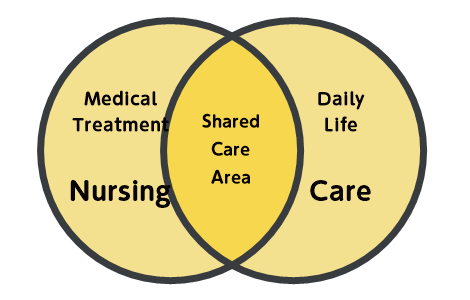
Nursing and care have overlapping areas.
In a hospital setting, nurses put their expertise to work, but once a patient is discharged and life at home begins, most of that support falls to the care worker.

Care workers continually ask themselves what they can do for the happiness of the people they support, and aim to remain a presence that connects society, people, and resources, walking alongside them.
In this process, cooperation with medical professionals is indispensable, and the relationship with nurses in particular is one of the strongest partnerships.
Understanding and collaborating on each other's areas of expertise is essential.

In the Care Worker Program at Shinshu Sports College, you can obtain the following qualifications in addition to the national Care Worker qualification.
We also determine each student's internship placement based on their own wishes, choosing from more than 200 partner facilities — training you can't get from a textbook alone.
Because you learn directly from staff on the actual front lines of care, you graduate ready to contribute immediately.

Qualifications available through our Care Worker Program

  • National Care Worker qualification
  • Care Prevention Exercise Instructor
  • Junior Sports Instructor for People with Disabilities
  • Japanese Red Cross First Aid Certificate
  • Red Cross Basic First Aid Course Completion Certificate
  • Red Cross Basic Life Support Certificate

If you are interested in becoming a Care Worker, we encourage you to visit an Open Campus event to hear from current students and experience the atmosphere of the school for yourself!
Our students, faculty, and staff will be there to make sure you have a valuable and welcoming visit.

Please feel free to contact us with any questions.